The Path of Water: Investing in the Andes to Secure South America’s Economic Future
By Florent Kaiser, CEO, Global Forest Generation
Co-founder, Acción Andina
Water Security Is Economic Security
South America’s water crisis is no longer an environmental problem. It’s an economic one.
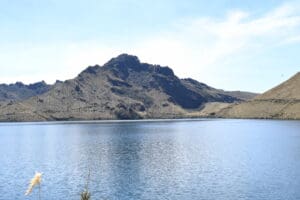
The Andes — the continent’s hydrological spine — sustain 140 million people and 236 cities across both the Amazon and Pacific basins. Each year, these mountain ecosystems regulate about 700 billion m³ of water, according to our mapping analysis with international water data expert Bluerisk. They power hydroelectric plants, irrigate crops, and supply industries and homes alike.
But this lifeline is under threat. Glaciers are retreating faster than at any point in recorded history, rainfall is becoming erratic, and wetlands and grasslands are drying. According to AntarcticGlaciers.org, tropical Andean glaciers are now smaller than they have been in the entire history of human civilization, and up to 70 percent could disappear by 2050.
In Ecuador, a single drought season caused 14-hour blackouts over four months and a 2% GDP loss — proof that water insecurity translates directly into economic instability. Protecting the ecosystems that power industries and sustain the region’s water flow is no longer optional; it is essential for the continent’s resilience and prosperity.
The Private Sector’s Water Dependence
Every major sector — agriculture, mining, hydropower, textiles, manufacturing, and tourism — runs on water. So do the banks, insurers, and investors behind them. When water fails, supply chains and portfolios crumble. Yet, less than one percent of global investment in nature-based solutions goes to Latin America’s water systems, even though each dollar invested in natural infrastructure yields US$ 7 to US$ 30 in long-term economic benefits through avoided losses and increased productivity.
For the private sector, investing in healthy ecosystems is not philanthropy; it’s the resilience of business.

The Path of Water: A Continental Mission
At Global Forest Generation, we are pursuing what we call The Path of Water, a continental effort to restore and protect the ecosystems that sustain life and prosperity across South America.
Through our restoration initiative in the Andes, Acción Andina, tens of thousands of Indigenous and local community members across six Andean countries have already restored degraded lands, planting nearly 15 million native trees and protecting the sources of water for millions downstream. Recognized by the United Nations as a World Restoration Flagship and winner of the 2023
Earthshot Prize, Acción Andina is now evolving into a movement to restore entire watersheds and sustain economic and social wellbeing.
Our recent mapping with Bluerisk identified 11.5 million hectares of high-priority Andean ecosystems for restoration — areas whose recovery would most directly secure water for both the Amazon and Pacific basins. This provides a science-based roadmap for scaling natural infrastructure where it matters most.
Equally important, our model is rooted in the Andean principles of Ayni and Minka — reciprocity, cooperation, and collective care for life. For the communities leading this work, restoration goes beyond replanting trees; it brings back water, dignity, and self-determination.
Financing Water Resilience
Restoring ecosystems at the scale required will demand private capital and innovative finance mechanisms that make investing in nature simple, credible, and de-risked.
Ecuador’s recent debt-for-nature swap, Peru’s Obras por Impuestos program, and Payment for Ecosystem Services schemes already show that nature can deliver tangible economic and social returns. The challenge now is to connect and scale these models under a continental vision for water resilience.

Acción Andina is now beginning to build the capacity to make this possible. In Peru’s Chincha Valley, Textil del Valle (TDV), Patagonia, and Lacoste are partnering with us and local communities to restore wetlands and reforest upstream catchments, improving local water regulation while securing TDV’s own water-dependent supply chain. Implemented in the field by lead Acción Andina partner Asociación Ecosistemas Andinos (ECOAN), this high-Andean restoration project shows how businesses can become co-pilots in restoration, aligning ecological health with business resilience.
Looking ahead, the next major step is the creation of a regional finance mechanism dedicated to climate resilience and water security — globally relevant, regionally ambitious, and nationally anchored. This includes exploring blended-finance mechanisms, outcome-based funding, and private-sector participation. Development banks such as CAF, IDB, and the World Bank, together with global funds like the Green Climate Fund and Global Environment Facility, can play a catalytic role by providing concessional finance and guarantees that reduce risk for early investors. NGOs like ours can test and prove these models, creating the trust and transparency needed for large-scale investment.
A Continental Opportunity
The Andes are more than mountains, they are South America’s natural infrastructure. If the continent’s next growth chapter depends on water, then restoring the ecosystems that produce it is not an environmental choice, but an economic imperative.
The communities we work with through Acción Andina are ready. They know what must be done. The question is whether governments and investors can act fast enough to secure the source of the region’s prosperity before it runs dry.
Ultimately, the Path of Water is the path to stability, resilience, and shared growth for South America.